Metre
The metre defines a basic framework for the rhythmic structure of music. A piece of music is usually divided into sections of equal length. These sections are called bars.
At the beginning of a staff
- At the very beginning of every staff the clef is placed. It defines the tonal range to be represented by that staff.
- The clef is followed by the key signature, which is represented by a group of accidentals (sharp, flat, or natural symbols). The key signature is valid for the whole length of the staff. It indicates the key of a piece.
- The key signature is followed by the time signature. It defines the metre of a piece. It consists of two numbers stacked on each other. The upper number defines the number of beats per bar. The lower number defines which note value equals one beat.
Bars
- A piece is divided into bars, which are separated by bar lines.
- Right before the first bar sometimes there is an incomplete bar, which is called upbeat. When counting the bars, it is omitted.
- Accidentals within a bar are valid for only this bar.
- The key and the metre can change within a piece.
Example of a staff:
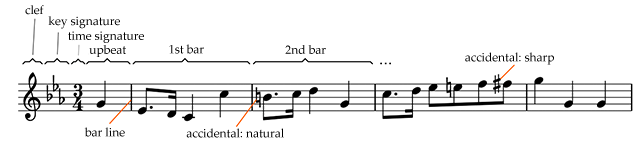
In this example for a staff you can find:
- A treble clef . It defines that the note G4 (in German: g') is placed on the second staff line. (For ukulele, only the treble clef is used).
- A key signature which defines that for this piece, the notes E, A and B are flattened by a half note. This indicates that a possible key for this piece is C minor.
- A time signature which defines that the metre of this piece is 3/4. So, every bar has a length of 3 beats, which have the duration of a quarter note each.
- The upbeat has the duration of one quarter note in this piece.
- In the 2nd bar there is a natural which cancels the flattening of the note B within only this bar.
- In the 3rd bar there are one natural and one sharp sign, these are valid for only this bar.
Metre and beat
Music is usually based on a beat. The individual beats are not necessarily hearable, however they are like the pulse of the music and define the temporal progress of a piece of music. Usually there are some "strong" and some "weak" beats. The reoccuring pattern of strong and weak beats in a piece of music constitutes the metre. In an orchestra, the conductor visualizes the metre by movements of his hands.
The metre is defined by the two numbers of the time signature:
- The upper number defines the number of beats of every bar.
- The lower number defines which note value has the same length as one beat.
Some important metres
4/4 metre

The 1st and the 3rd beat of every bar are stressed (the 3rd a little bit less). This metre is usually denoted by the letter C instead of two "4"-digits ("common time").
2/2 metre: ("alla breve")

This time is usually denoted by a vertically crossed out letter C ("cut time"). This metre is often used by fast pieces. The 1st beat of every bar is stressed.
3/4 metre: (Waltz)

The 1st beat is stressed. A waltz is a "rolling", usually not overly fast rhythm.
More metres
- 2/4 metre: More uniform than 4/4. Many marches are in this metre.
- 6/8 metre: A more vivid triple metre. Here, the 1st and the 4th beat are stressed.
The tempo
The tempo defines, well... the tempo of the beat, usually in beats per minute (BPM). In classical music, quite often italian tempo definitions are used. Some examples with rough guide values:
- Largo: ca. 50 BPM -- broad, very slow
- Adagio: ca. 65 BPM -- slow, calm (expressive)
- Andante: ca. 85 BPM -- at walking pace
- Moderato: ca. 100 BPM -- moderate speed
- Allegro: ca. 120 BPM -- fast, quickly
- Presto: ca. 170 BPM -- very fast


